Morocco Visa for Pakistani Citizens: Are You Eligible?
Quick Answer
Price with evis.ma: USD 169 for Standard processing (1-3 business days) or USD 229 for Urgent processing (1 business day). Each price includes the government fee and the service fee. Full fee breakdown
Core Information
Morocco eVisa requirements for Pakistani citizens
Summary: A Pakistani passport alone does not qualify for the Morocco eVisa. You are eligible only if you also hold an accepted multiple-entry visa (valid at least 90 days) or residence permit (valid at least 180 days) from a recognised country. The eVisa is a single-entry authorisation for tourism, business or family visits. If you hold neither document, a consular visa is the correct route.
Required documents
| Document | Who needs it | Condition |
|---|---|---|
| Ordinary passport | Every applicant | Valid for more than 90 days on the day you apply and for your whole stay in Morocco; diplomatic and service passports are not accepted |
| Passport bio-page scan | Every applicant | A clear, complete image of the photo page |
| Photo | Every applicant | Any recent, clear photo of your face; a phone photo or a selfie is fine, and we adjust it to the portal's format |
| Qualifying visa or residence permit | Applicants not eligible on the passport alone | A multiple-entry visa valid at least 90 days, or a residence permit valid at least 180 days, issued by an accepted country |
| Payment card | Every applicant | For the visa fee |
Processing time
- Standard: 1–3 business days
- Urgent: 1 business day
Visa validity
- Single entry — one entry per eVisa
- Validity: up to 180 days from the issue date (the window to enter Morocco)
- Length of stay: up to 30 days per visit
Entry conditions
- A Pakistani passport alone does not qualify — you must also hold an accepted multiple-entry visa or residence permit
- Accepted multiple-entry visa: valid at least 90 days, from the Schengen Area, the United States, the United Kingdom, Ireland, Canada, Australia, New Zealand or Japan
- Accepted residence permit: valid at least 180 days, from the European Union (except Cyprus), the United States, the United Kingdom, Canada, Australia, New Zealand, Japan, Norway, Switzerland or the United Arab Emirates
- If you hold neither, apply for a consular visa at the Moroccan embassy or consulate
Important notes
- The supporting document must be genuine, currently valid and in your own name
- A single-entry visa does not qualify — the visa must be multiple-entry
- The eVisa is single-entry, and its 180-day validity is the deadline to enter, not the length of stay
- If you hold no qualifying document, a consular visa is the correct route
For Pakistani travellers, the real question is whether you qualify
A Pakistani passport does not open the eVisa on its own; what decides your case is a second document you already hold. So the first question is never “how do I apply” but “do I qualify” — everything else follows from that answer.
The tie has a striking origin. In 1952, when France blocked Morocco's independence envoy Ahmed Balafrej from addressing the UN Security Council, Pakistan issued him a Pakistani passport so that he could speak — and Balafrej went on to become independent Morocco's first foreign minister.
Which documents make you eligible
Eligibility rests on a second document you already hold. Morocco accepts two kinds, and they are not interchangeable — one is a visa, the other a residence permit:
An accepted multiple-entry visa. A valid multiple-entry visa issued by the Schengen Area, the United States, the United Kingdom, Canada, Australia, New Zealand, Japan or Ireland. It must remain valid for at least 90 days from your arrival in Morocco. A single-entry visa does not qualify.
An accepted residence permit. A valid residence permit issued by any European Union country except Cyprus, the United States, the United Kingdom, Canada, Australia, New Zealand, Japan, Norway, Switzerland or the United Arab Emirates. It must remain valid for at least 180 days from your arrival.
The document must be genuine, currently valid and in your own name. Because these conditions decide the whole trip, confirm yours with the eligibility check before you rely on it.
Where Pakistani applicants qualify: the UK first, then Europe and the Gulf
Of the 102 Pakistani applications submitted through evis.ma between February and October 2026, 57 came from people living in the United Kingdom, 18 from EU countries and 7 from the Gulf. The large Pakistani community in Britain makes UK status the most common qualifying document: a British residence permit or UK digital status valid for at least 180 days from your arrival in Morocco, or a multiple-entry UK visa valid for at least 90 days.
In the Gulf the line is sharper. A UAE residence permit valid for at least 180 days from arrival qualifies; a Saudi iqama does not, and neither do residence permits from Qatar, Kuwait, Bahrain or Oman. A Pakistani living in Saudi Arabia therefore qualifies only through another accepted document — a multiple-entry visa from the Schengen Area, the United States, the United Kingdom, Ireland, Canada, Australia, New Zealand, Norway or Japan, valid for at least 90 days, or a residence permit from a country on the accepted list — or applies for a consular visa.
If you hold none of these documents
Then the online eVisa is not the right channel, and Morocco is entered on a consular visa obtained through the Moroccan embassy or consulate responsible for Pakistan, which handles the application in person.
Check before you apply
Because eligibility turns entirely on your supporting document, confirm it first. Run the eligibility check; if you qualify, our Morocco eVisa guide sets out the documents, fees and processing times.
Frequently Asked Questions
Travel Guides for Pakistan
View All Articles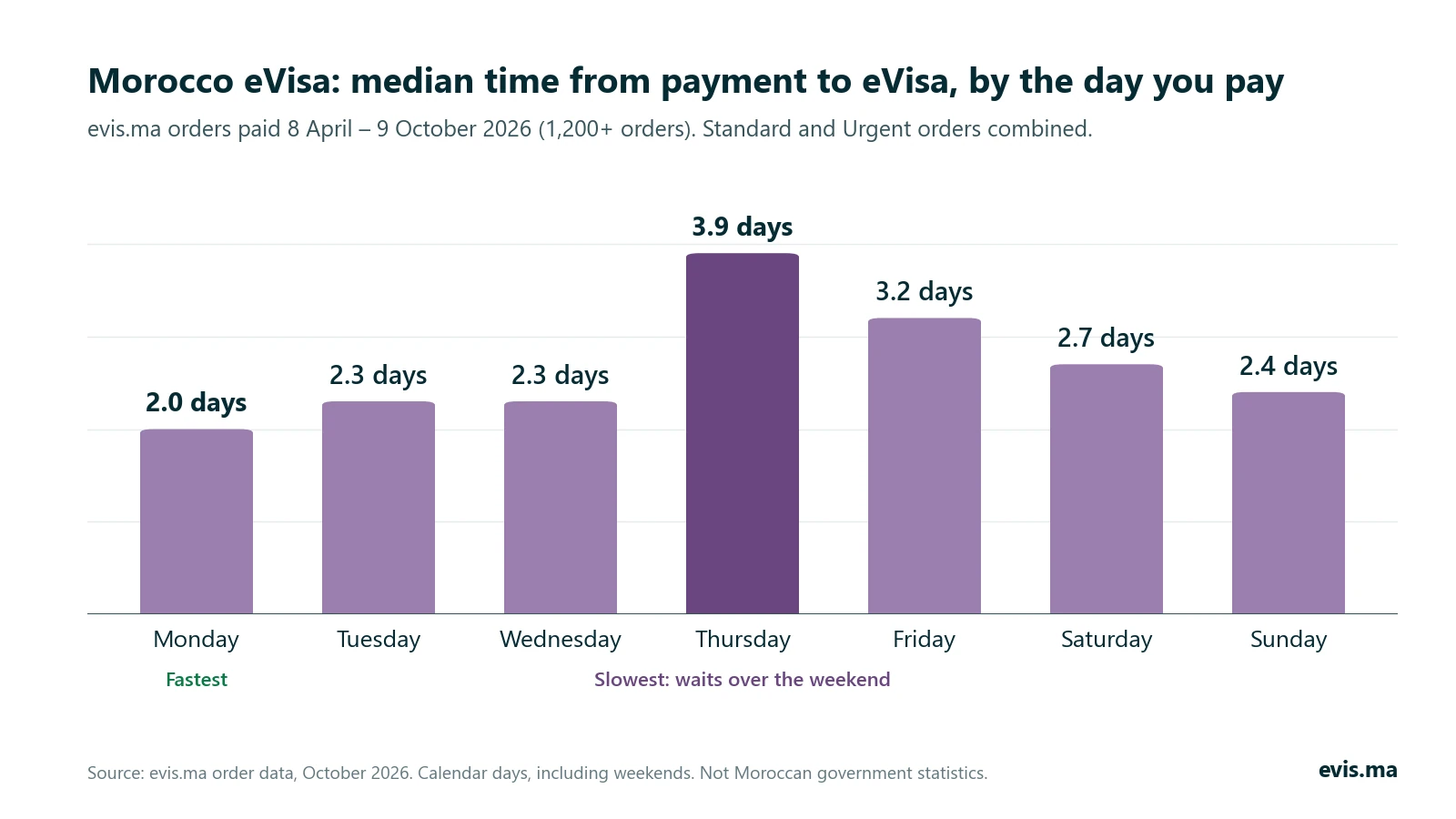
What Pakistan Citizens Say
I applied for a visa and I received it with 3 working days they reply to what’s app or email that on website but they replied straight away to the payment confirmation email if your trying to get it t...
Was having an issue with e visa but it got fixed pretty quickly when I reached out to their number provided. Quick and responsive 👍🏻