Does a UAE residence permit make you eligible for the Morocco eVisa?
Yes, for some passports. A UAE residence permit is one of the residence permits accepted as a supporting document for the Morocco eVisa. It counts when two things are true: your nationality uses the eVisa route that requires a supporting document, and the permit stays valid for at least 180 days from your planned arrival in Morocco. Your passport must also be valid for more than 90 days on the day you apply, and for your whole stay in Morocco.
The UAE is the only Gulf state on that list. Between February and October 2026, about 1 in 15 Morocco eVisa applications submitted through evis.ma came from people living in the UAE, and about 1 in 9 from people living in one of the six Gulf states.
One exception applies: a UAE residence permit is not accepted for citizens of Côte d'Ivoire. They need another document from the list of qualifying documents.
What to have ready from the UAE
Prepare both documents that show your UAE residence: clear images of the front and the back of your Emirates ID, and your UAE residence visa.
Which passports can use a UAE residence permit?
Your nationality is checked first, and your UAE residence matters only after that. The same permit does different things for different passports:
| Your passport | What your UAE residence permit does |
|---|---|
| eVisa with the passport alone, for example India or Jordan | Nothing extra is needed. You apply with your passport, and the permit is not required. |
| eVisa with a supporting document, for example Pakistan, Egypt or Nigeria | It can be your supporting document if it is valid for at least 180 days from your arrival. |
| Côte d'Ivoire | Not accepted. Use a qualifying visa or a residence permit from another accepted country. |
| Embassy visa only, for example Syria | It does not open the eVisa. The visa is issued by a Moroccan embassy or consulate. |
| Visa-free, for example the six Gulf states | Nothing is needed. You can visit Morocco without a visa for up to 90 days. |
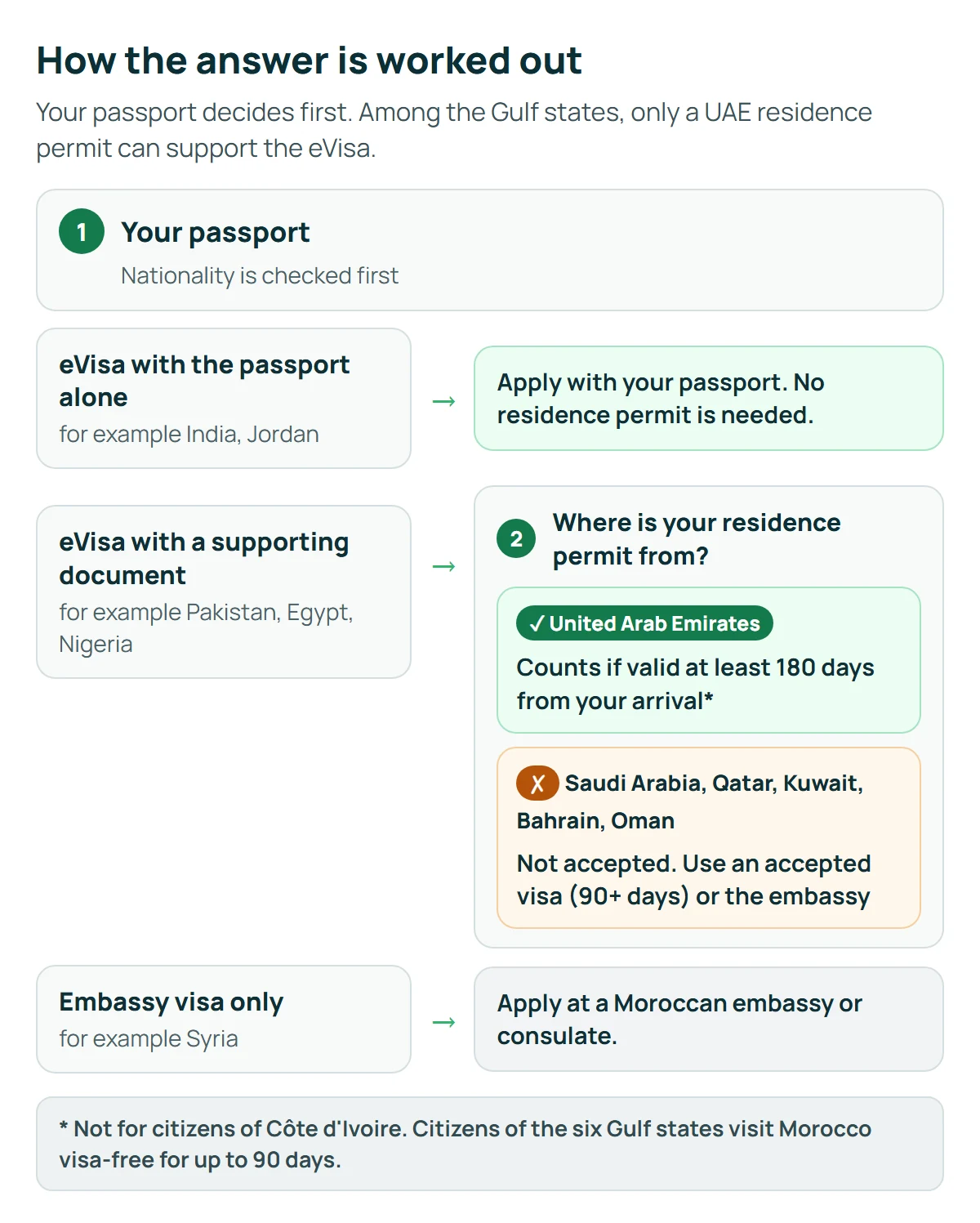
The checker gives the answer for your passport in one step, and the country directory lists every nationality.
Do Saudi, Qatari, Kuwaiti, Bahraini or Omani residence permits count?
No. Residence permits from Saudi Arabia (the iqama), Qatar, Kuwait, Bahrain and Oman are not accepted for the Morocco eVisa, whatever their validity. If your passport needs a supporting document and you live in one of these countries, two eVisa options remain:
- a multiple-entry visa issued by the Schengen Area, the United States, the United Kingdom, Ireland, Canada, Australia, New Zealand, Norway or Japan, valid for at least 90 days from your arrival. Electronic visas and travel authorisations, such as a US ESTA or a UK ETA, count;
- a residence permit from another accepted country, valid for at least 180 days from your arrival.
If your second document comes from the UK, Morocco visa for UK residents covers UK residence status and visas. If it is an EU, Norwegian or Swiss residence permit or a Schengen visa, see the Morocco visa for EU residents and Schengen visa holders. Without a qualifying document, the eVisa is not open to you, and the last section of this page shows where to apply instead.
How long must your UAE residence permit be valid?
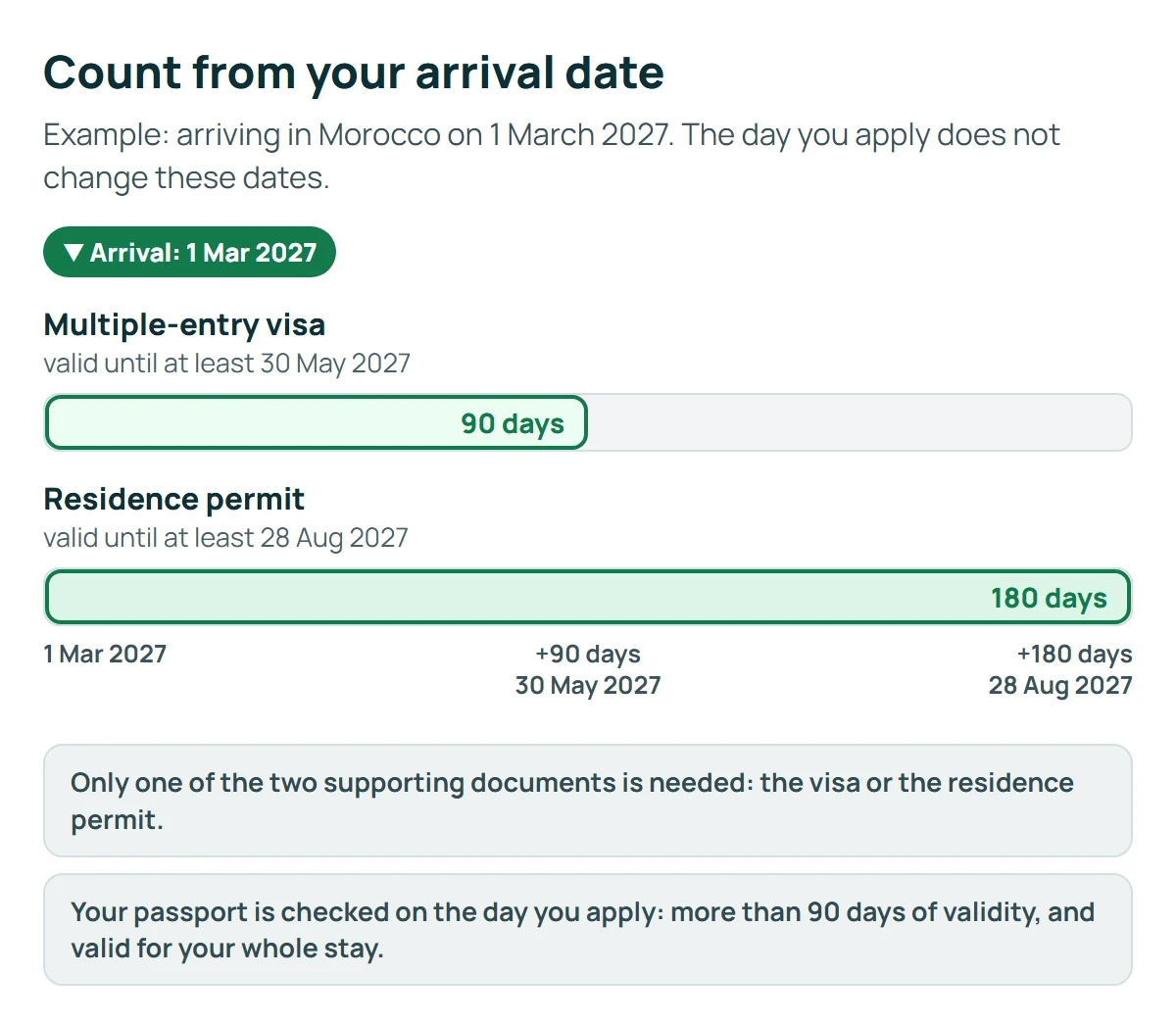
At least 180 days from the day you plan to arrive in Morocco, not from the day you apply. If you arrive on 1 March 2027, your permit must be valid until at least 28 August 2027.
If you rely on a visa instead, it must be multiple-entry and valid for at least 90 days from arrival: for the same arrival on 1 March 2027, until at least 30 May 2027. In both cases your passport must be valid for more than 90 days on the day you apply, and for your whole stay.
Before you apply: our printable Morocco eVisa supporting document guide (PDF, 2 pages) lists every accepted visa and residence permit, shows how to count the 180 days from your arrival date, and explains what to do if your permit or visa does not have enough validity left.
Do citizens of the UAE and other Gulf states need a visa for Morocco?
No. Citizens of the United Arab Emirates, Saudi Arabia, Qatar, Kuwait, Bahrain and Oman can enter Morocco without a visa for up to 90 days, so they do not need the eVisa. The rules for every nationality are summarised in Morocco's visa policy.
Can you get a visa on arrival in Morocco from the Gulf?
No. Morocco does not issue visas on arrival, so a Gulf residence permit cannot replace a visa at the airport. If your passport needs a visa, get the eVisa or an embassy visa before you fly. Visa on arrival in Morocco explains the difference between visa-free entry and a visa.
How much does the Morocco eVisa cost and how long does it take?
The same as for every applicant: $169 with standard processing (1–3 business days) or $229 with urgent processing (1 business day). Living in the Gulf does not change the price or the timing. The eVisa allows one entry and a stay of up to 30 days, within 180 days of issue. What the Morocco eVisa costs breaks the price down.
Where to apply if the eVisa is not open to you
If your nationality cannot use the eVisa, or you have no qualifying document, the visa is issued by a Moroccan embassy or consulate. In the UAE, Morocco has an embassy in Abu Dhabi and a consulate in Dubai: see the Moroccan Embassy in the United Arab Emirates. In Saudi Arabia, see the Moroccan Embassy in Saudi Arabia, which also has a consulate in Jeddah.
Qatar, Kuwait, Bahrain and Oman each have a Moroccan embassy too; their pages are in the embassy directory.
Once you know your route, the complete Morocco eVisa guide walks through the application.