Travelling to Morocco from the UK: two different answers
There is no single answer for everyone living here. If you hold an ordinary British passport, you do not need a Morocco visa or an eVisa — you travel visa-free. If you live in the UK on any other passport, your nationality is checked first, and your residence status only matters after that. Those two situations are answered separately below.
Nearly one in three Morocco eVisa applications submitted through evis.ma comes from someone living in the UK: 251 of 814 between February and October 2026. Pakistani (57) and Nigerian (38) passports are the most common among them, followed by Indian (26), Ghanaian (12), Zimbabwean (11), Bangladeshi (10) and Nepali (10). The rule depends on the passport, not on the UK address; the Pakistan and Nigeria pages set it out for the two largest groups.
If you hold a British passport
Holders of an ordinary British passport can enter Morocco visa-free for stays of up to 90 days. You do not need to apply for a Morocco eVisa before travelling.
If you want the underlying rule rather than the short answer, it sits in Morocco's visa policy. Otherwise, this page has already answered your question — the rest of it is written for people in the UK who hold a different passport.
If you live in the UK on another passport
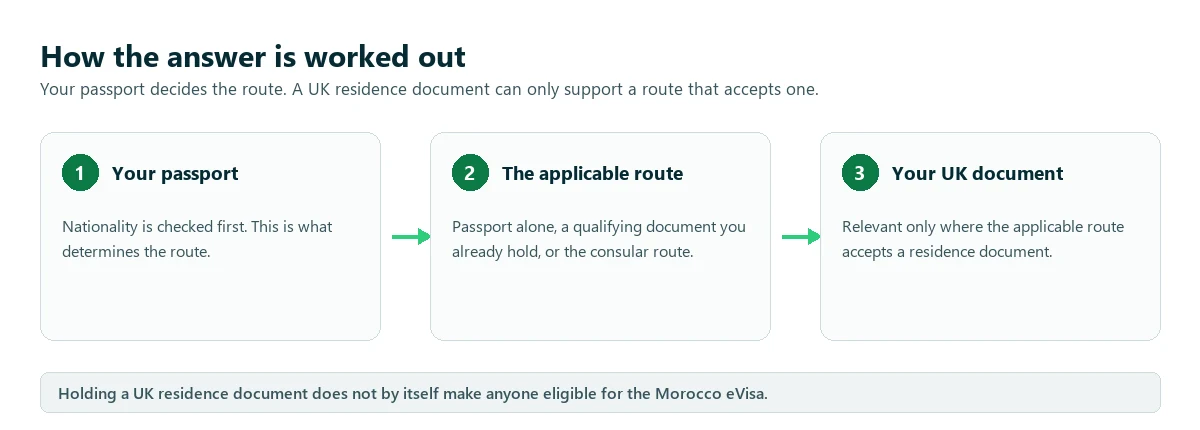
If you hold a non-UK passport and live in the UK, your nationality determines which Morocco visa route may apply. Being resident here does not place you in a separate Morocco category, and it does not change what your passport requires.
What it can do — in one of the routes described below — is provide a supporting document that the route accepts. Whether that route applies to you at all depends on your nationality, which is the first thing to establish. Use the eligibility checker on this page, or find your nationality in the Country Directory.
Your nationality decides first
Morocco sorts travellers by the passport they hold before anything about their residence is considered. The main routes are described below. Which route applies depends on your nationality and the requirements in force for your passport. This page does not decide which one applies to you; the checker and the individual country pages do that, and they are the only place a specific answer is given.
Reading them in order helps, because they are not variations on a theme. They are genuinely different processes with different evidence behind them, and knowing which one you are in changes what you should be preparing and where you should be looking next.
Nationalities that can use the eVisa with their passport alone
For some nationalities the passport is sufficient. If yours is one of them, you apply on the strength of your passport and nothing else about where you live is relevant to eligibility. A UK residence document adds nothing here, because there is nothing for it to add.
This is worth knowing before you spend time gathering paperwork. People in this group sometimes assemble residence evidence they were never going to be asked for, simply because they found guidance written for a different route.
Nationalities that qualify through a document they already hold
For others, the passport on its own is not enough, and eligibility depends on holding a particular visa or residence document issued by another country. This is the only route in which a UK-issued document can carry any weight, and it is the reason so many people living here reach this question in the first place.
Which documents are accepted, and the conditions attached to each of them, are maintained in which documents make you eligible. That page is the reference; this one covers only the part that is specific to documents issued in the UK. Residence permits from the UAE and the other Gulf states are covered in the Morocco visa for UAE and GCC residents. EU, Norwegian and Swiss residence permits and Schengen visas are covered in the Morocco visa for EU residents and Schengen visa holders.
Nationalities that must use the embassy route
For some nationalities the eVisa is not open at all, and the application has to go through a Moroccan consulate instead. A UK residence document does not, by itself, change the visa route that applies to your passport. If this is your situation, the last section of this page points you to the right place.
Does your UK residence status help?
Sometimes — and only within the second of the routes above. It is worth being precise about what "helps" means here, because this is where most of the misunderstanding happens.
UK residence does not make anyone eligible for the Morocco eVisa on its own. It can support an application where the applicable route accepts a residence document. If your nationality does not use that route, your residence status has no bearing on the outcome, however secure or long-standing it is.
That distinction matters more than it might sound. Residence status is often the strongest document a traveller holds, and it is natural to assume it carries the most weight. In this system it is supporting evidence within one route, not a qualification in itself.
UK BRP and UK digital (eVisa share code) residence status
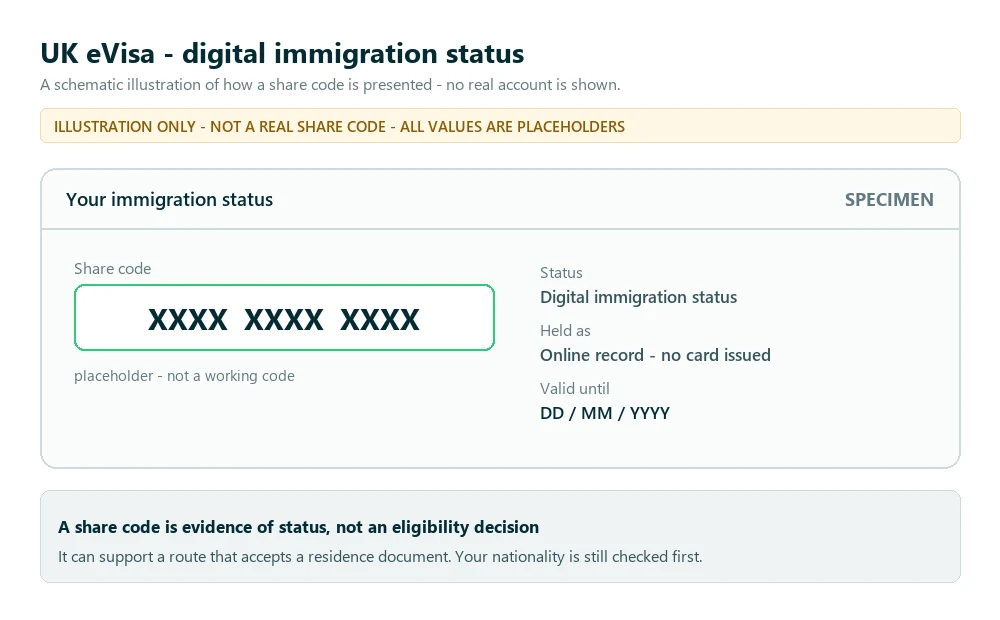
UK residence status evidenced by a biometric residence permit (BRP) or by a UK eVisa share code is accepted as a qualifying residence document. BRP cards expired on 31 December 2024, so UK status is now proved online through your UKVI account — with a share code or a screenshot of your status. In the eVisa application form, the field that still asks for a residence permit (BRP) number takes your share code; you no longer need the number of your old BRP card.
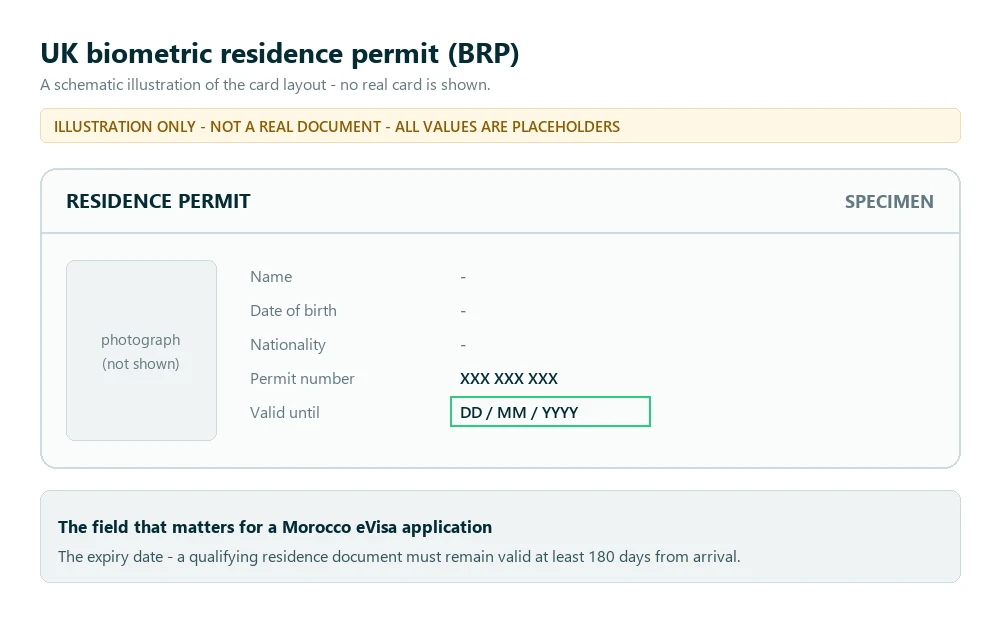
Read "accepted" carefully. It means the document itself is recognised, so it can be used where the route accepts a residence document. It does not mean that holding one establishes eligibility. The nationality question comes first and is answered independently of anything in your wallet.
Which UK statuses and visas count
Indefinite leave to remain (ILR), Student and Skilled Worker statuses count as a UK residence document when they are valid for at least 180 days from your arrival in Morocco; ILR has no end date, so it always meets that rule. A UK Standard Visitor visa counts as a UK visa when it is multiple-entry and valid for at least 90 days from arrival, and an electronic UK ETA counts in the same way.
How long your UK residence permit must remain valid
A qualifying residence document must remain valid for at least 180 days from your planned arrival date in Morocco.
The date that matters is the day you intend to arrive, not the day you apply. A permit that is comfortably valid today may still fall short if you are travelling several months from now, and checking this before you book is easier than discovering it afterwards.
If your document is close to that threshold, the practical question is whether it will still clear it on the arrival date you have in mind — not whether it clears it now.
If you qualify through a UK visa instead of residence
Some people rely on a visa rather than a residence permit. Where eligibility is based on a qualifying visa, that visa must remain valid for at least 90 days from your planned arrival date.
These are two different documents with two different thresholds: 180 days for a residence document, 90 days for a visa. Both are counted from arrival. If you hold both, work from whichever one your route actually relies on.
UK refugee travel documents are not accepted
A UK refugee travel document is not accepted for the Morocco eVisa. This holds even where the holder has UK residence status, and it is not something a longer validity period or an accompanying residence permit can resolve.
If this applies to you, the eVisa is not the route, and the consular option covered at the end of this page is the one to look at.
At this point the fastest way to see which route your passport falls into is the checker.
Before you apply: our printable Morocco eVisa supporting document guide (PDF, 2 pages) shows what to upload as proof of your UK digital status, how to count the 180 days from your arrival date, and what to do if your status ends too soon.
What you'll need to provide
What you are asked to supply depends on which route your nationality uses, so there is no single list that fits everyone reading this. Repeating a partial version here would only create a second, less reliable copy.
The complete requirements — what counts, what does not, and the conditions that apply to each document — are kept in qualifying documents for the Morocco eVisa. If your route relies on a UK-issued document, the validity thresholds in the previous section are the part that applies to you.
Everything else on that page applies to you in exactly the same way it applies to an applicant living anywhere else. Nothing about the requirements is written differently for residents here.
Fees and processing time
Standard processing is $169 and urgent processing is $229. What each covers, and how the pricing is structured, is set out in what the Morocco eVisa costs.
There is no separate processing time for applicants applying from the UK. Being resident here neither speeds up nor slows down an application, and no UK-specific fee exists. If you have seen a figure presented as a UK rate, it is not one.
Applying once you know you're eligible
Once the checker or your country page has confirmed which route applies, the application itself is the same as it would be anywhere else — the same form, the same requirements for your route, the same handling.
The process end to end is documented in the complete Morocco eVisa guide. Confirm your route first; the guide assumes you already know it.
If the eVisa isn't open to you
If your nationality is not covered by the eVisa, or your circumstances fall outside it, the application goes through a Moroccan consulate rather than online. Contact details and the consular route for people in the UK are on the page for the Moroccan Embassy in London.
If anything about your case looks unusual, confirm it with the relevant Moroccan authority before you book. Do not rely on an airline agent, a forum post, or on us.