Can an EU residence permit get you a Morocco eVisa?
Yes, if your passport needs a supporting document. A residence permit issued by an EU country other than Cyprus, or by Norway or Switzerland, counts when it stays valid for at least 180 days from your planned arrival in Morocco. A multiple-entry Schengen visa valid for at least 90 days from your arrival counts too, even if you do not live in Europe. Your passport must be an ordinary passport, valid for more than 90 days on the day you apply and for your whole stay in Morocco.
Between February and October 2026, 233 of the 814 Morocco eVisa applications submitted through evis.ma, about 2 in 7, came from people living in the EU, Norway or Switzerland. The largest groups lived in Germany (48), France (36), Spain (33) and Ireland (23). The three largest passport groups among them were Indian (31), Ukrainian (29) and Pakistani (20): the rules for each are on the India, Ukraine and Pakistan pages.
Which EU residence cards count
The name of the card does not matter. A French titre de séjour, a German Aufenthaltstitel, a Spanish TIE, an Italian permesso di soggiorno, an Irish IRP, an EU Blue Card, student and work permits, and residence cards for family members of EU citizens all count. In the applications we have handled, the eVisa portal accepted each of these card types. Upload clear images of the front and the back of the card.
Residence permits for temporary protection, issued to people displaced from Ukraine, count under the same 180-day rule; in applications we have handled they were accepted, though a few were refused. Check the date on your document. The current EU temporary protection period ends on 4 March 2027, so a permit or extension that expires that day covers arrivals in Morocco only until 5 September 2026. The EU has extended temporary protection until 4 March 2028 (Council Implementing Decision (EU) 2026/1912), and a permit or extension showing the new date counts again, for arrivals until 6 September 2027.
Which passports can use an EU residence permit or a Schengen visa?
Your nationality is checked first, and your EU residence or Schengen visa matters only after that. The same document does different things for different passports:
| Your passport | What an EU residence permit or a Schengen visa does |
|---|---|
| eVisa with the passport alone, for example India | Nothing extra is needed. You apply with your passport, and the permit or visa is not required. |
| eVisa with a supporting document, for example Pakistan, Ukraine, Egypt or Nigeria | It can be your supporting document: a residence permit valid for at least 180 days, or a multiple-entry Schengen visa valid for at least 90 days, from your arrival. |
| Embassy visa only, for example Syria | It does not open the eVisa. The visa is issued by a Moroccan embassy or consulate. |
| Visa-free, for example every EU country, Norway, Iceland, Liechtenstein and Switzerland | Nothing is needed. You can visit Morocco without a visa for up to 90 days. |
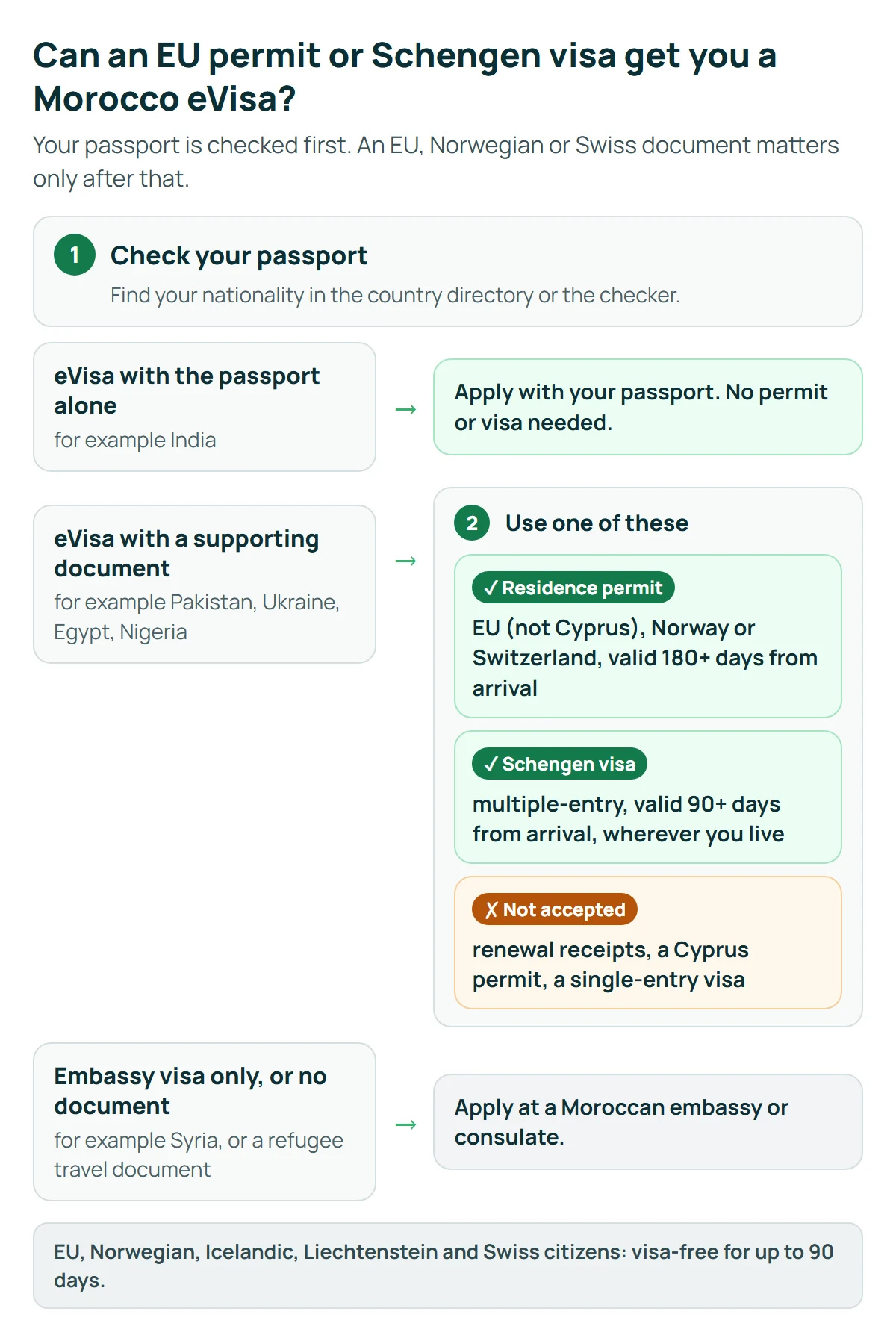
The checker gives the answer for your passport in one step, and the country directory lists every nationality.
Does a Schengen visa count if you do not live in Europe?
Yes. A multiple-entry Schengen visa in your passport is a supporting document on its own, wherever you live and whichever Schengen country issued it, if it is valid for at least 90 days from your arrival in Morocco. A single-entry Schengen visa does not count.
The Schengen Area is one of nine accepted visa issuers. The others are the United States, the United Kingdom, Ireland, Canada, Australia, New Zealand, Norway and Japan, and electronic visas and travel authorisations from them, such as a US ESTA or a UK ETA, count as well. Morocco visa qualifying documents lists every accepted visa and residence permit.
What does not count as your supporting document?
- A receipt for a residence permit that is being renewed or issued, such as a French récépissé, an Italian ricevuta or a Spanish resguardo. Only the residence card itself counts.
- A residence permit from Cyprus. Cyprus is the only EU country whose permits are not on the list.
- A single-entry Schengen visa, or a multiple-entry visa with less than 90 days left after your arrival.
- A residence permit with less than 180 days left after your arrival.
- A refugee travel document or a stateless person's travel document. The eVisa needs an ordinary national passport, so holders of these documents apply at a Moroccan embassy or consulate.
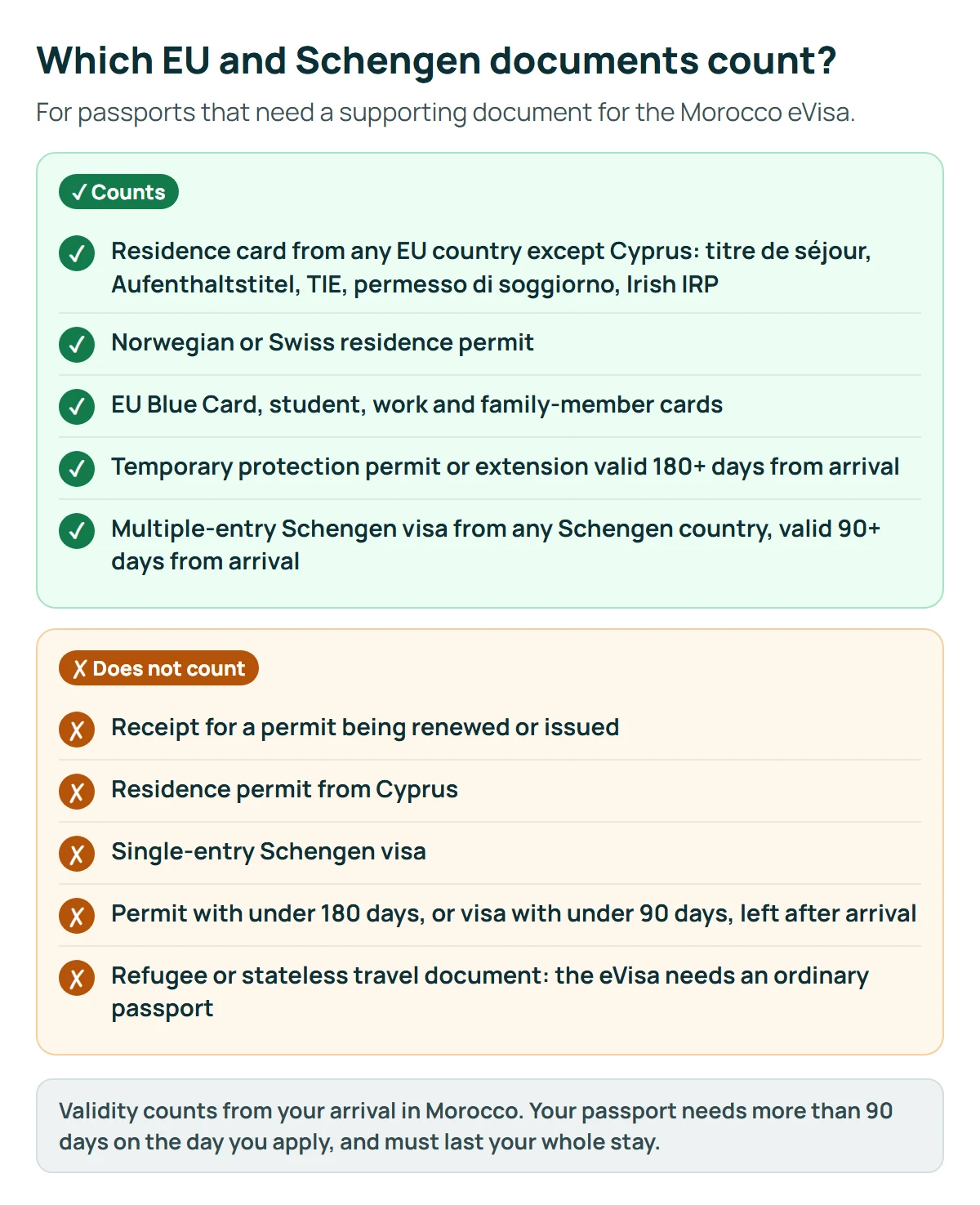
How long must your residence permit or Schengen visa be valid?
A residence permit must be valid for at least 180 days from the day you plan to arrive in Morocco, not from the day you apply. If you arrive on 1 March 2027, your permit must be valid until at least 28 August 2027.
A multiple-entry Schengen visa must be valid for at least 90 days from arrival: for the same arrival on 1 March 2027, until at least 30 May 2027. In both cases your passport must be valid for more than 90 days on the day you apply, and for your whole stay. If your document falls short, the qualifying documents page explains the options.
Do EU, Norwegian and Swiss citizens need a visa for Morocco?
No. Citizens of every EU country, Norway, Iceland, Liechtenstein and Switzerland can enter Morocco without a visa for up to 90 days, so they do not need the eVisa. The rules for every nationality are summarised in Morocco's visa policy.
How much does the Morocco eVisa cost and how long does it take?
The same as for every applicant: $169 with standard processing (1–3 business days) or $229 with urgent processing (1 business day). Living in Europe does not change the price or the timing. The eVisa allows one entry and a stay of up to 30 days, within 180 days of issue. What the Morocco eVisa costs breaks the price down.
Where to apply if the eVisa is not open to you
If your nationality cannot use the eVisa, or you have no qualifying document, the visa is issued by a Moroccan embassy or consulate in the country where you live. Morocco has missions across Europe, for example in Germany, France, Spain, Italy and Ireland. The other countries are in the embassy directory.
If you live in the UK or the Gulf instead, see Morocco visa from the UK or Morocco visa for UAE & GCC residents. Once you know your route, the complete Morocco eVisa guide walks through the application.